
Beyond the Basics: When to Reach Out for Consultation Related to Using ACT & Inhibitory Learning in Treating OCD
To improve therapeutic options and outcomes when working with clients who have OCD, clinicians may seek to enhance the well-established, gold standard behavioral treatment of Exposure and Response Prevention (ERP) with other evidence-based approaches. These therapeutic frameworks include Acceptance and Commitment Therapy (ACT) and the inhibitory learning model. As you move into implementing a more advanced and integrative treatment approach, the question of when to seek clinical consultation becomes increasingly important. Below, we’ve outlined key indicators to help you determine when and how a consultation with a specialist can be beneficial. For each indicator, we offer examples of how an ACT orientation and/or an inhibitory-learning lens can deepen your clinical thinking and enhance your treatment approach and outcomes with OCD clients.
When to Seek Consultation
You can’t figure out how to target the obsessional or compulsive content the client is bringing to session.
Some items on an exposure menu can seem untouchable, such that they may be considered too challenging or too difficult to implement.
ACT: Pull on some or all of the core processes of psychological flexibility to help make forward movement in treatment. For example, drawing upon values and connecting these to committed action ERP steps can make challenging exposure targets more approachable.
Inhibitory learning: Widen the lens through which the purpose and outcomes of ERP are viewed. In addition to being a behavioral experiment set up to disconfirm feared outcomes, ERP can involve inviting new experiences and learning along for the ride.
Consultation can generate fresh ideas for creating and designing exposures, weaving in values work, and increasing psychological flexibility.
It seems like you’re playing “whack-a-mole” with OCD symptoms across different domains.
OCD can be awfully wily. Just when it feels like you’re making progress in one domain, new obsessions and compulsions can pop up.
ACT: Consider broadening the focus of ERP exercises to include greater emphasis on acceptance, moving away from treatment goals that are exclusively focused on reducing symptoms in different domains.
Inhibitory learning: Recalibrating ERP exercises in line with this model can help the client generalize new learning and experiences from one symptom domain to other domains. It may also be useful to enhance the extent to which new learning in ERP competes with existing beliefs about what it means to make contact with obsessional content.
A consultation can help you re-formulate. Perhaps we need to look at OCD from a different perspective and drill down on the function of the behaviors.
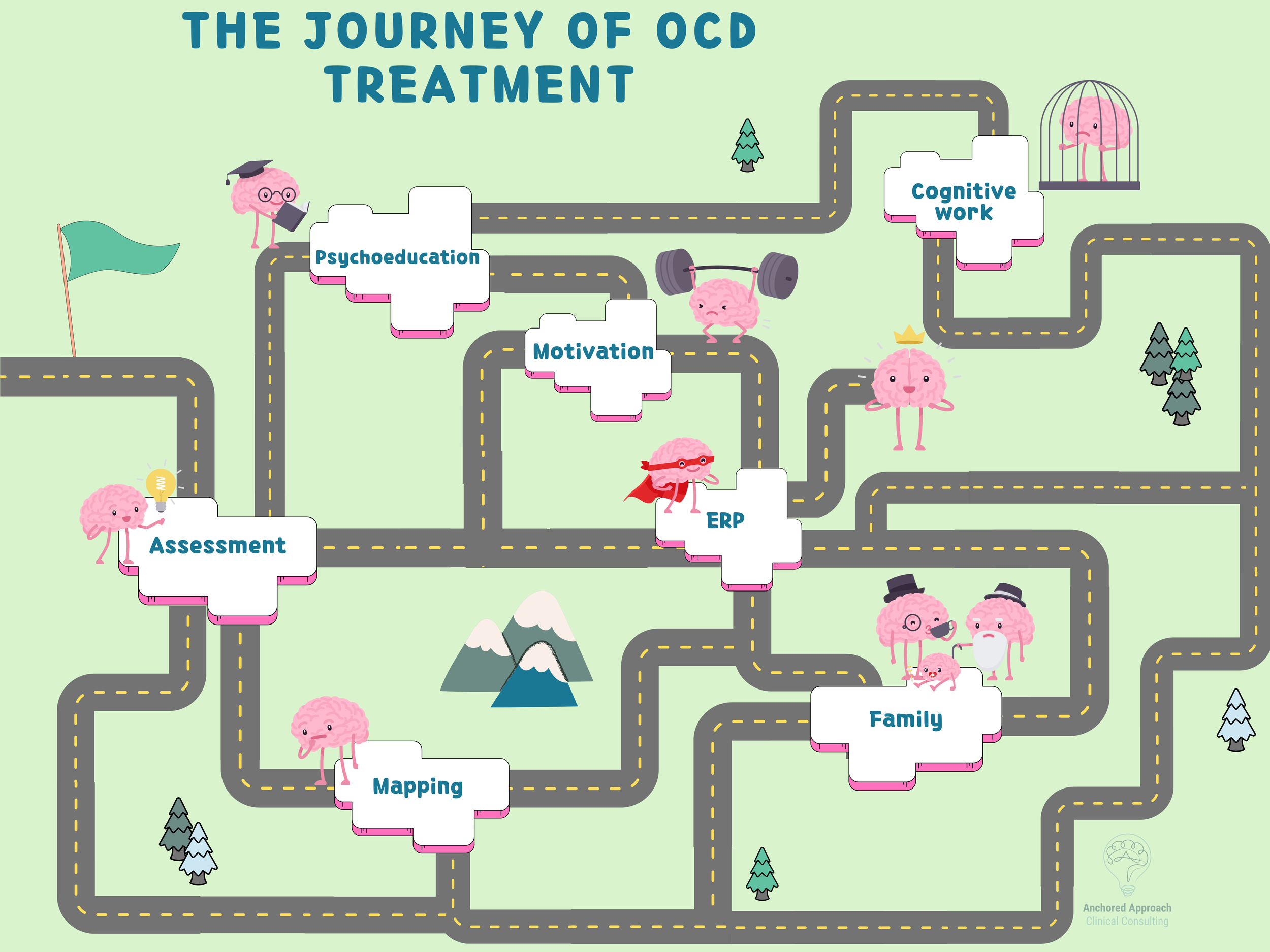
Navigating all the destinations of the treatment journey
When progress has plateaued or your client does not appear to be making reliable gains in treatment.
Progress can be slow or minimal when a client’s motivation is low or when ERP exercise just aren’t hitting the mark.
ACT: Double back to values and utilize creative hopelessness when OCD’s pitch to the client to resist change has become too convincing.
Inhibitory learning: Work on combining obsessional cues in ERP, increasing expectancy violations, remove safety signals and try frequently changing gears with respect to the intensity or challenge of ERP exercises.
If you’re still feeling stuck, consultation can help you find new ways to approach ERPs, conceptualize treatment, and communicate ideas to your client.
When it seems there is so much work to be done, and you can’t decide where to start with your client.
When you’re not sure where to even begin, or if you would like to learn to incorporate an evidence-based framework to up your skillset, consultation can provide a compass for taking steps toward enhancing your work with OCD clients. You can use your time to focus on specific clients and put theory to practice.